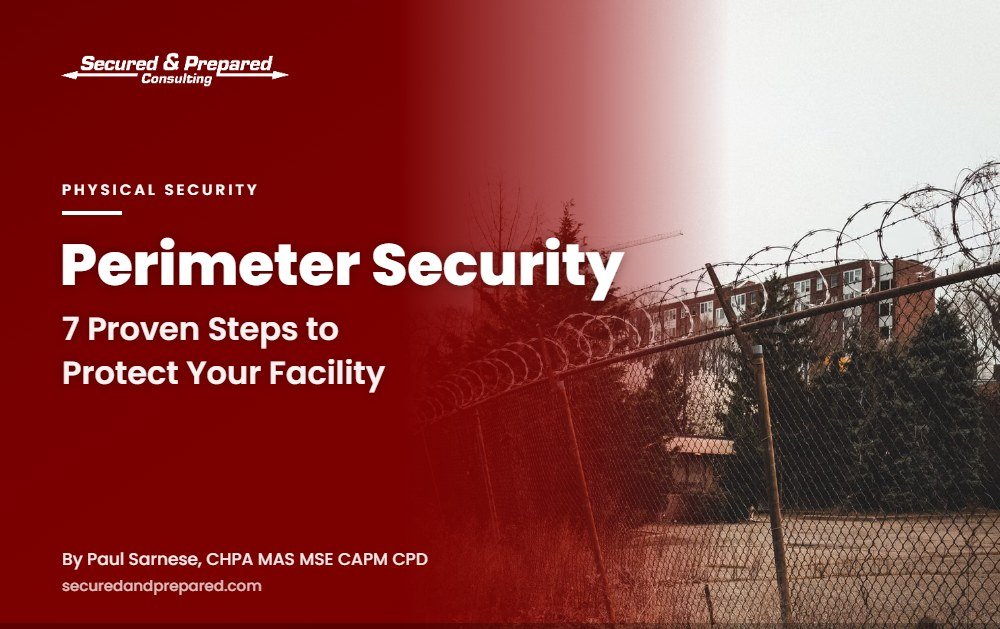
Before anyone talks about cameras, access control or officer deployment, there is one question every facility leader should be able to answer with confidence: have you clearly defined the physical boundaries of your property? Perimeter security is where every effective protection strategy begins, and yet it is one of the most overlooked parts of a security program.
It sounds basic. But without a clearly defined and assessed perimeter, every other security investment you make is operating without a reference point. Cameras get placed where they are convenient rather than where they matter. Lighting gets added after an incident rather than before one. Officers patrol areas that were never mapped against real risk.
In this article, Paul Sarnese of Secured & Prepared Consulting walks through why perimeter security matters so much, what organizations commonly get wrong, and seven proven steps you can take to build a perimeter that actually works for you.
What Is Perimeter Security?
Perimeter security is the set of physical, technical and procedural measures that define and protect the outer boundary of a property. It covers everything from fencing, gates and bollards to lighting, signage, landscaping, surveillance coverage and the policies that govern who can cross that line and when.
Think of your property as a series of rings. The outer ring is your property line. The next ring might be your parking areas and building approaches. Then come the building entrances, and finally the sensitive interior spaces such as pharmacies, server rooms, executive suites or patient care units. This is the core idea behind layered security, sometimes called defense in depth.
The outermost ring sets the tone for everything inside it. When that ring is clearly defined, every layer behind it can be designed with purpose. When it is vague, the gaps carry forward into every layer.
In practice, that means perimeter security decisions should be made deliberately and documented, rather than left to whoever happens to be managing a construction project or responding to the latest complaint. A shared, written understanding of the boundary keeps every department working from the same plan.
Why Perimeter Security Is the Foundation of Layered Protection
A clearly defined perimeter gives your organization four practical advantages that are difficult to achieve any other way.
1. Barriers and deterrents go exactly where they matter
Fences, gates, bollards and landscaping are expensive. When you know precisely where your boundary is and how people and vehicles approach it, you can invest in the right barrier at the right location instead of spreading budget thinly across the whole site.
2. Surveillance and lighting deliver real coverage
Camera placement and lighting design should follow the perimeter, not the other way around. A defined boundary lets your team position cameras to cover approach routes, blind corners and entry points with overlapping fields of view.
3. Your security team can monitor with confidence
Controlled zones only work when everyone understands where they begin and end. Officers, staff and contractors need a shared picture of which areas are public, which are restricted and what the response should be when someone crosses the line.
4. First responders get clear reference points
When an incident is reported, police, fire and EMS need to know exactly where to go. Defined gates, numbered entrances and clearly mapped zones shave critical minutes off response times.
Common Perimeter Security Mistakes Organizations Make
In assessments across healthcare, education, government and corporate campuses, the same patterns appear again and again.
- Assuming the property line is the perimeter. Legal boundaries and practical security boundaries are often different. Shared parking structures, public sidewalks and neighboring businesses all complicate the picture.
- Patching vulnerabilities one at a time. Organizations add a camera here and a lock there after each incident, without ever addressing the underlying structural gap.
- Ignoring vehicle approach routes. Pedestrian access often gets attention while vehicle threats to entrances and crowded areas go unassessed.
- Letting landscaping undermine visibility. Overgrown shrubs and poorly placed trees create concealment and blind spots right where surveillance needs to see.
- No documentation. If the perimeter only exists in the head of one facilities manager, it does not really exist as part of the security program.
The problems keep surfacing because the foundation was never properly established. Strong perimeter security fixes the cause instead of chasing the symptoms.
7 Proven Steps to Strengthen Your Perimeter Security
Here is the approach we use at Secured & Prepared Consulting when we begin any physical security engagement.
Step 1: Map the boundary as it actually functions
Walk the entire site with a map in hand. Mark the legal property line, but also mark where people and vehicles actually enter, where paths are worn into the grass, where fences end and where neighboring properties blend into yours. This working map becomes the reference point for every later decision.
Step 2: Identify every access point
List every gate, driveway, loading dock, pedestrian path and building entrance. Note which ones are staffed, which are controlled electronically and which are simply open. Many facilities discover access points during this step that nobody had formally accounted for.
Step 3: Assess vehicle threats
Look at approach angles, speed potential and stand off distance at entrances, emergency departments, plazas and anywhere people gather. Where vehicles can reach crowds or critical infrastructure, physical barriers such as crash rated bollards deserve serious consideration.
Step 4: Apply CPTED principles
Crime Prevention Through Environmental Design uses natural surveillance, territorial reinforcement and access control to make a perimeter work harder. Trimmed landscaping, clear sight lines, defined walkways and well marked transitions between public and private space all reduce opportunity for bad actors.
Step 5: Align lighting and surveillance with the boundary
Once the boundary is mapped, design lighting and camera coverage around it. Focus on entrances, parking areas, approach routes and transitions between zones. Make sure cameras are positioned for identification, not just general observation.
Step 6: Define zones and response protocols
Label each area as public, semi public, restricted or highly restricted. Then write down what staff and security officers should do when someone is found in the wrong zone. Clear, documented expectations remove guesswork under pressure.
Step 7: Test, train and reassess
A perimeter is not a one time project. Construction, new tenants, seasonal changes and organizational growth all shift your boundary over time. Schedule regular walk throughs, run exercises with first responders and reassess after any significant change to the site.
How Perimeter Security Supports Compliance and Liability Protection
For healthcare organizations in particular, a documented perimeter strategy supports regulatory expectations around environment of care and workplace violence prevention. Guidance from agencies such as the Cybersecurity and Infrastructure Security Agency (CISA) consistently emphasizes layered physical protection that starts at the outer boundary.
There is also a liability dimension. When an incident occurs, one of the first questions asked is whether the organization took reasonable, foreseeable steps to protect people on its property. A documented perimeter assessment, with clear findings and a plan to address them, is strong evidence of due diligence. Our litigation support and expert witness work shows again and again how much weight that documentation carries.
Where to Start With Perimeter Security at Your Facility
If your organization has not formally assessed its perimeter in the last two or three years, that is the place to begin. Even facilities with mature security programs often find that their boundary has drifted as the campus has grown.
At Secured & Prepared Consulting, a perimeter assessment is always where we start. It shapes every recommendation that follows and makes sure your security investment builds something coherent and defensible rather than a collection of disconnected fixes. It also feeds directly into broader work such as security program development and security system design and project management.
Perimeter security will never be the most exciting part of a protection plan. But it is the part that makes every other part work.
Perimeter Security Considerations by Facility Type
Hospitals and healthcare campuses
Hospitals must stay open to the public every hour of every day, which makes perimeter security a balancing act. The goal is not to wall the campus off but to channel people and vehicles through a small number of well designed, well monitored entry points. Emergency departments, parking structures and after hours entrances usually need the most attention.
Schools and universities
Educational campuses often grew over decades with buildings added wherever space allowed. That history leaves behind open courtyards, unmonitored side doors and paths that cut through the middle of the property. A defined perimeter helps administrators decide which routes stay open during the school day and which close when a lockdown is called.
Government and corporate facilities
Offices and government buildings tend to have more control over who arrives, but they also face higher expectations for protecting executives, sensitive information and critical operations. Here, perimeter security often focuses on stand off distance, visitor screening and controlled vehicle access to loading areas.
Frequently Asked Questions About Perimeter Security
How often should a facility reassess its perimeter?
At a minimum every two to three years, and immediately after any major construction, change in occupancy or serious incident. Sites that change frequently benefit from an annual walk through.
Is perimeter security only about fences?
No. Fences are one tool among many. Lighting, landscaping, signage, cameras, bollards, staffing and written procedures all contribute. Some of the strongest perimeters have very little fencing at all.
Can perimeter security make a facility feel unwelcoming?
It does not have to. Good design uses landscaping, architecture and wayfinding to guide people naturally. Visitors should feel welcomed through the right entrance while the rest of the boundary quietly does its job.
What is the first step if we have never assessed our perimeter?
Start with a professional walk through and a working map of how people and vehicles actually move across the site. That single exercise usually reveals the most important gaps within a few hours.
Perimeter Security Technology That Actually Helps
Technology should support a well designed perimeter, never replace one. With the boundary mapped and zones defined, the right tools can extend what your team sees and how quickly it responds.
Detection at the boundary
Fence mounted sensors, buried cable systems, infrared beams and radar can detect someone climbing, cutting or crossing a boundary line. These systems are most useful along long stretches of fence that officers cannot watch continuously, such as the back of a campus, a utility yard or a remote parking lot.
Video analytics
Modern cameras can be configured to alert when a person or vehicle enters a defined zone at a defined time. Instead of asking an officer to watch dozens of screens, the system draws attention to the one view that matters. Analytics work best when the perimeter has already been clearly mapped, because every rule depends on knowing where the line is.
Access control at gates and entrances
Card readers, license plate recognition and intercoms at vehicle gates let you control who enters without staffing every point around the clock. Logs from these systems also create a record that supports investigations and audits.
Lighting standards
Lighting is one of the most cost effective perimeter security measures available. Even, consistent illumination along walkways, parking areas and entrances supports both natural surveillance and camera performance. Dark gaps between fixtures are exactly where problems tend to happen.
Building a Realistic Perimeter Security Budget
Few organizations can fix every perimeter issue at once, and they should not try to. A practical budget follows the risk.
- Start with low cost, high impact fixes. Trimming landscaping, repairing broken fencing, improving signage and adjusting lighting often cost very little and close real gaps quickly.
- Prioritize by consequence. Areas where a breach would put people at greatest risk, such as emergency departments, childcare areas and main entrances, come first.
- Phase capital projects. Fencing, bollards and detection systems can be spread across several budget cycles as long as the overall plan stays consistent.
- Fold perimeter work into planned construction. Renovations and new buildings are the cheapest time to add conduit, foundations for barriers and camera positions.
- Document every decision. A written plan shows leadership, insurers and regulators that risks were identified and addressed in a reasonable order.
Perimeter security spending is easier to justify when it is tied to a clear assessment rather than a reaction to the last incident.
A Practical Perimeter Security Checklist
Use this short checklist as a starting point for your next site walk. If you cannot confidently answer yes to most of these questions, a formal assessment will likely uncover meaningful gaps.
- Do we have a current, written map of our working perimeter, not just our legal property line?
- Have we identified and documented every pedestrian and vehicle access point?
- Are all entrances either staffed, electronically controlled or deliberately locked?
- Is lighting even and consistent along walkways, parking areas and entrances?
- Do cameras cover approach routes and entrances with enough detail to identify people?
- Is landscaping maintained so it does not create hiding places or block sight lines?
- Have we assessed where vehicles could reach crowds or building entrances at speed?
- Do staff and security officers know which areas are public, restricted and highly restricted?
- Have local police, fire and EMS been given maps and reference points for our site?
- Have we reassessed the perimeter since our last major construction or change in use?
What a Professional Perimeter Security Assessment Includes
A professional assessment goes beyond a quick walk around the building. At Secured & Prepared Consulting, it typically includes a review of site plans and past incident data, interviews with security, facilities and clinical or operational leaders, daytime and nighttime site walks, and an evaluation of how people and vehicles actually move across the property.
The findings are organized by risk level, with clear recommendations, rough cost ranges and a suggested order of work. That gives leadership a practical roadmap instead of a long list of disconnected problems. It also creates the documentation that regulators, insurers and attorneys look for when they ask whether an organization took reasonable steps to protect people on its property.
Key takeaways
- Perimeter security is the foundation every other security layer depends on.
- Your working perimeter is often different from your legal property line.
- Map, assess, prioritize and document before you buy technology.
- Reassess regularly, because sites and risks change over time.
How Perimeter Security Connects to Emergency Planning
A well defined perimeter makes emergency plans far easier to execute. During a lockdown, staff need to know which doors to secure and which gates to close. During an evacuation, they need to know where people should gather and how responders will arrive. During a severe weather event or utility failure, facilities teams need to know which access points must stay open for emergency vehicles.
When perimeter security and emergency management program development are planned together, these decisions are made calmly in advance instead of under pressure in the moment. That coordination saves time, reduces confusion and protects lives.
Talk to Paul Sarnese About a Perimeter Assessment
Paul Sarnese, CHPA MAS MSE CAPM CPD, has spent his career helping hospitals, schools, government agencies and corporations build security programs that hold up when it counts. If you would like to discuss what a perimeter assessment looks like for your facility, contact Secured & Prepared Consulting or call 856.305.9204.
Stay safe, stay prepared.