Vehicle based attacks on public and institutional facilities happen far more often than most organizations plan for. Hospitals, schools, government buildings, pharmacies and busy pedestrian areas have all been targeted, sometimes deliberately and sometimes by a distracted or impaired driver. In many of those cases, the damage could have been prevented or sharply reduced with properly placed security bollards.
Bollards are among the most cost effective physical security tools available. Yet they are often installed for looks, placed by guesswork, or left out of security plans entirely. In this article, Paul Sarnese of Secured & Prepared Consulting explains why security bollards deserve a place in your protection strategy and six powerful ways to make sure they actually work.
The ideas below apply to hospitals, schools, government buildings, retail locations and corporate campuses alike.
What Are Security Bollards?
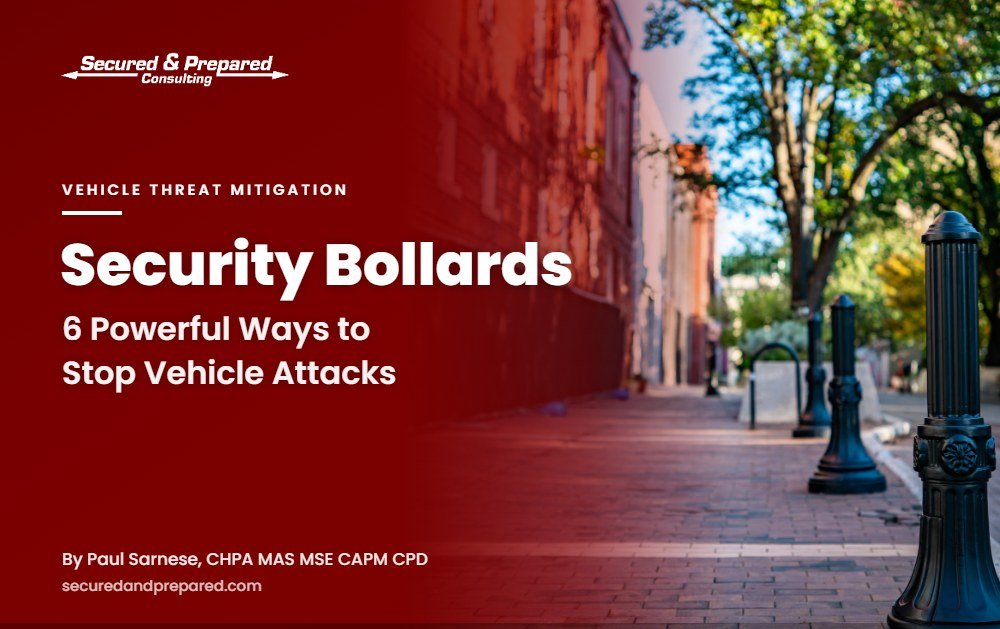
Security bollards are short, sturdy vertical posts designed to control or stop vehicle access while still allowing people to walk freely between them. They range from decorative posts that guide traffic to crash rated barriers engineered to stop a heavy truck traveling at speed.
The key distinction is between decorative or traffic bollards and true security bollards. A decorative bollard might keep cars off a sidewalk at low speed, but it will not stop a determined attacker. Crash rated security bollards are tested against specific vehicle weights and impact speeds, and that rating should match the threat your site actually faces.
Choosing between the two is not a matter of taste. It depends on what each location needs to stop. A sidewalk next to a quiet service road may only need traffic guidance, while a hospital entrance facing a long, straight driveway may need the strongest protection available. Treating every location the same either wastes money or leaves people exposed, which is why careful planning comes first.
Why Vehicle Threats Deserve Serious Attention
Vehicles are widely available, require no special skill to operate and can cause catastrophic harm in seconds. Federal guidance from the Cybersecurity and Infrastructure Security Agency (CISA) highlights vehicle ramming as a real concern for crowded places and soft targets.
High risk facilities often work from the assumption that they are not likely targets. That assumption is exactly what makes them vulnerable. Emergency department entrances, hospital drop off zones, school pick up lines, outdoor dining areas and building lobbies with glass frontage all share the same risk factors: people gather there, and vehicles can reach them.
Accidental incidents matter too. A driver who confuses the gas and brake pedal at a front entrance can do as much damage as a deliberate attack. Security bollards protect against both.
The good news is that this is a solvable problem. With a clear understanding of where people gather and how vehicles approach, most facilities can dramatically reduce their exposure with a focused, well planned investment rather than a complete redesign of the site.
6 Powerful Ways to Use Security Bollards Effectively
1. Start with a site assessment, not a catalog
The most common mistake is choosing bollards before understanding the site. A proper assessment looks at approach angles, the distance a vehicle can travel to build speed, entry configurations and where people congregate. Placement driven by real data provides real protection. Placement driven by aesthetics usually does not.
2. Match the crash rating to the actual threat
Not every location needs the highest rated barrier, and not every location can get by with a decorative post. Look at the realistic vehicle size and speed for each approach. A long straight driveway leading to a main entrance calls for a much stronger solution than a tight, slow turn in a parking garage.
3. Protect entrances and gathering areas first
Prioritize the places where the consequences of a vehicle breach would be most severe. Main entrances, emergency departments, glass storefronts, outdoor waiting areas and plazas usually top the list. Building a perimeter around those critical zones first delivers the most protection per dollar.
4. Keep pedestrian and emergency access open
Good bollard design stops unauthorized vehicles without trapping people or blocking ambulances and fire apparatus. Spacing should allow wheelchairs, strollers and foot traffic to pass comfortably. Where emergency vehicles need access, removable or retractable security bollards keep that route open while maintaining protection the rest of the time.
5. Use bollards to define and communicate your perimeter
Security bollards do more than stop vehicles. They create a visible boundary that tells everyone your organization takes protection seriously. Combined with lighting, signage and landscaping, they reinforce where public space ends and controlled space begins. This ties directly to a well defined perimeter security strategy.
6. Inspect, maintain and document
Bollards get hit, corrode, shift and sometimes get removed during construction and never replaced. Retractable models need regular mechanical checks. Schedule inspections, keep records and include bollards in your annual security review so the protection you paid for stays in place.
Security Bollards and Healthcare Facilities
Hospitals face a unique challenge. They must remain open and welcoming around the clock while protecting patients, visitors and staff. Emergency departments in particular combine heavy vehicle traffic, urgent arrivals and crowds of vulnerable people in a small space.
Thoughtfully placed security bollards let a hospital keep ambulance bays and drop off zones fully functional while protecting waiting areas and entrance glass. They also support broader workplace violence program assessments and environment of care planning by closing a gap that many programs never address.
How Much Do Security Bollards Cost?
Costs vary widely depending on crash rating, foundation requirements, finish and whether the bollards are fixed, removable or automated. What stays constant is the comparison: the cost of a well placed bollard line is a small fraction of the human, financial and reputational cost of a single vehicle incident at an unprotected entrance.
The smartest way to control cost is to place the right level of protection exactly where it is needed and nowhere else. That is only possible with a professional assessment.
Types of Security Bollards
Fixed bollards
Fixed bollards are permanently anchored in a deep foundation. They offer the highest level of protection for locations where vehicles should never pass, such as building frontages, plazas and pedestrian walkways.
Removable bollards
Removable bollards lock into a ground sleeve and can be taken out with a key. They work well where occasional vehicle access is needed, such as for maintenance or deliveries, but they depend on staff remembering to put them back.
Retractable and automatic bollards
Retractable bollards rise and lower on command, either manually or through hydraulic or electric systems tied to access control. They suit controlled vehicle entrances, emergency access routes and secure loading areas. They cost more and require regular maintenance, but they combine strong protection with flexibility.
Decorative and architectural bollards
Many modern security bollards are hidden inside planters, benches, light fixtures or sculptural covers. These designs let organizations add serious protection without making the entrance look like a fortress, which matters a great deal for hospitals, schools and customer facing businesses.
Common Mistakes When Installing Bollards
- Spacing them too far apart. Gaps wider than a small car defeat the purpose. Spacing must balance pedestrian comfort with vehicle stopping power.
- Choosing decorative posts for a security job. A post that looks strong is not the same as one that has been crash tested.
- Ignoring the foundation. A bollard is only as strong as what holds it in the ground. Shallow installation can turn a barrier into a projectile.
- Leaving the ends open. A line of bollards that stops short of a wall or curb simply tells a driver where to go around.
- Forgetting emergency access. Blocking fire lanes or ambulance routes creates a new safety problem while solving another.
Frequently Asked Questions About Security Bollards
Do security bollards really stop vehicles?
Properly rated and installed security bollards are tested to stop specific vehicles at specific speeds. The key is matching the rating to the realistic threat at each location.
How far apart should bollards be placed?
Spacing is typically set so that a vehicle cannot pass between them while people, wheelchairs and strollers can. Exact spacing depends on the product and the site, which is why a professional assessment matters.
Will bollards make our entrance look unwelcoming?
Not necessarily. Architectural covers, planters and integrated designs allow strong protection that blends into the building and landscape.
Where should we install bollards first?
Start where people gather and vehicles can reach them at speed: main entrances, emergency departments, glass frontages, plazas and outdoor waiting areas.
Understanding Crash Ratings for Security Bollards
Crash rated security bollards are tested by driving a vehicle of a known weight into them at a known speed and measuring how far the vehicle travels past the barrier. Ratings are typically expressed as a combination of vehicle type, impact speed and penetration distance.
For facility leaders, the important point is not memorizing the rating codes. It is understanding that a rating only means something when it matches the realistic threat at a specific location. A heavy truck needs a long, straight run to reach high speed. A small car can accelerate quickly over a short distance. A professional site assessment measures those approach routes so the rating you pay for matches the risk you actually face.
It is also worth remembering that the rating applies to the whole system, including the foundation. A crash rated bollard installed without the specified foundation does not carry its rating.
Security Bollards in Schools, Government and Retail Settings
Schools and universities
Student drop off zones, outdoor gathering areas, athletic events and building entrances combine large groups of people with heavy vehicle traffic. Security bollards can separate pick up lanes from waiting areas and protect main entrances without making the campus feel closed.
Government buildings
Courthouses, municipal buildings and public service offices often sit close to busy streets with glass entrances and public plazas. Here, security bollards and stand off distance are central to protecting both employees and the public who come to the building for services.
Retail, pharmacies and storefronts
Storefront crashes happen more often than many people realize, whether from deliberate smash and grab attempts or drivers who mistake the accelerator for the brake. Bollards along parking spaces that face glass storefronts are a simple and effective safeguard for customers and staff inside.
Corporate campuses and event spaces
Lobbies, outdoor dining areas and event lawns all benefit from a defined vehicle boundary. Temporary or removable security bollards can also protect seasonal events and large gatherings.
A Security Bollards Planning Checklist
Before buying or installing any barrier, work through these questions with your security, facilities and design teams.
- Where do people gather close to areas that vehicles can reach?
- What is the longest straight approach a vehicle could take toward each of those areas?
- Which locations need permanent protection and which need flexible access?
- Where must emergency vehicles, deliveries and maintenance trucks be able to pass?
- Are there underground utilities that will affect foundation design?
- How will bollards blend with landscaping, lighting and building architecture?
- Who will be responsible for inspecting, maintaining and documenting the system?
- How do security bollards fit with our overall perimeter, camera and access control plan?
Clear answers to these questions lead to security bollards that protect people, respect the design of the property and hold up for years.
Why Professional Assessment Matters
It is tempting to treat bollards as a simple purchase. In reality, the difference between effective and ineffective protection usually comes down to decisions made before installation: where the line goes, how strong it needs to be, how it handles emergency access and how it fits the rest of the security program.
An experienced consultant brings a structured approach to those decisions. That includes measuring approach routes, reviewing how people actually use the site, coordinating with architects and engineers, and making sure the final design is documented in a way that supports budgeting, construction and future audits. The result is protection that is right sized, defensible and built to last.
Real World Lessons From Vehicle Incidents
Across many vehicle incidents at public buildings and crowded spaces, a few lessons come up again and again. Attackers and careless drivers alike tend to follow the path of least resistance. Wide, open approaches to entrances invite trouble. Glass frontages offer little protection on their own. And in many cases, a simple line of properly rated security bollards would have stopped the vehicle before it reached anyone.
Another consistent lesson is that protection must be continuous. A single gap in a line of barriers, a removable bollard left out after a delivery or an unprotected side entrance can undo the value of everything else. That is why security bollards should always be planned as part of a complete perimeter rather than installed one location at a time.
Maintaining Security Bollards Over Time
Once security bollards are installed, they need care just like any other safety system. A simple maintenance program should include:
- Routine visual inspections for damage, leaning, rust and loose covers.
- Operational testing of retractable and automatic bollards, including emergency lowering functions.
- Key control for removable bollards so they are always replaced after use.
- Construction oversight to make sure barriers removed during projects are reinstalled correctly.
- Records of inspections, repairs and replacements to support audits and insurance reviews.
A barrier that no longer stands where it should provides no protection at all, so this ongoing care is just as important as the original design.
Key takeaways
- Vehicle threats are real for hospitals, schools, government buildings and retail spaces.
- Security bollards are one of the most cost effective ways to protect people from those threats.
- Placement and crash rating must be based on a professional site assessment.
- Emergency access, pedestrian comfort and design all matter alongside stopping power.
- Inspection and maintenance keep the protection in place for years to come.
How Security Bollards Fit Into a Layered Security Plan
Security bollards are most effective when they work alongside other layers of protection. Cameras watch the approaches and record any impact. Lighting keeps the barrier line visible at night. Access control manages which vehicles may pass through retractable sections. Signage and landscaping guide drivers along intended routes. And clear emergency procedures tell staff what to do if a vehicle threat develops.
Thinking about bollards as one part of this larger system prevents a common mistake: protecting the front entrance heavily while leaving side doors, loading docks or outdoor gathering spaces exposed. A layered plan looks at the whole site and places each tool where it delivers the most value. That approach also makes budgeting easier, because every purchase can be tied back to a specific risk and a specific location in the plan.
Get Expert Guidance on Security Bollards
Secured & Prepared Consulting has worked with facilities across healthcare, government, education and corporate sectors to assess vehicle threat exposure and design appropriate bollard solutions. That work often sits alongside our security system design and project management services so that barriers, cameras, lighting and access control all work together.
If vehicle threats are not part of your current security plan, now is the time to start that conversation. Contact Paul Sarnese or call 856.305.9204 to discuss a vehicle threat assessment for your facility.
Stay safe, stay prepared.