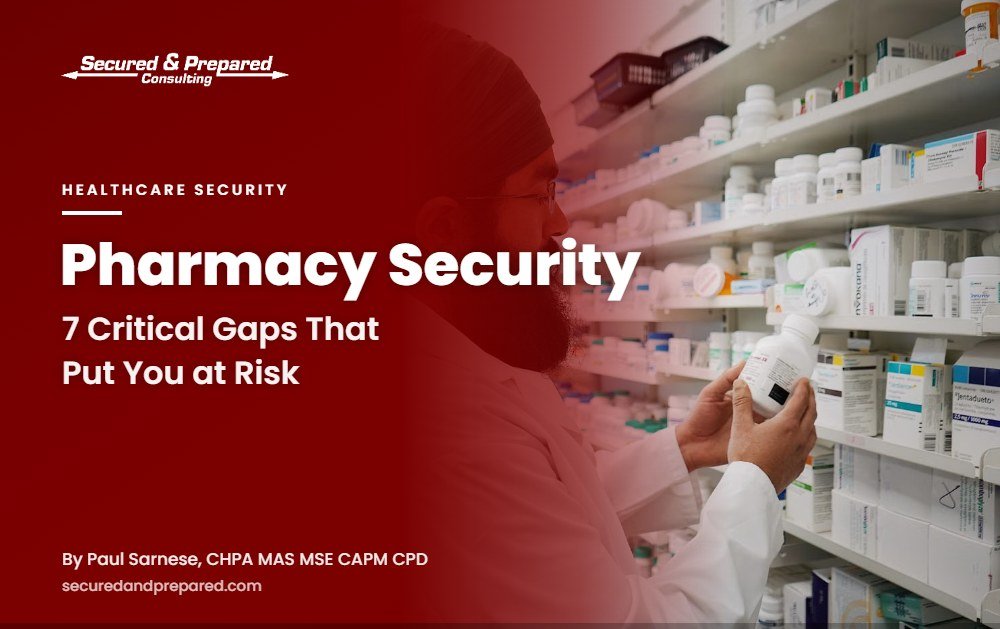
Controlled substances, high value medications and protected health information make pharmacies one of the most targeted and highest risk areas in any healthcare facility. And yet pharmacy security is routinely treated as an extension of general facility security rather than the specialized discipline it requires.
The result is coverage gaps that create real exposure to theft, drug diversion, regulatory non compliance and patient safety risk. In this article, Paul Sarnese of Secured & Prepared Consulting explains why pharmacies need their own security approach and walks through seven critical gaps that put facilities at risk.
Whether you oversee a hospital pharmacy, an outpatient clinic or a retail location, the gaps below are worth reviewing with your team, because most of them can be addressed with focused, practical changes rather than major new spending.
Why Pharmacy Security Needs Its Own Approach
A pharmacy is not just another department. It holds assets with high street value, it is subject to strict federal and state regulation, and the consequences of a failure reach far beyond financial loss. Diverted medications can harm patients, fuel addiction in the community and expose staff to danger.
The DEA Diversion Control Division places clear obligations on registrants to maintain effective controls against theft and diversion. Meeting those obligations takes more than a locked door and a camera in the hallway. It takes a security program designed around how a pharmacy actually works.
Effective pharmacy security starts with understanding exactly where the specific vulnerabilities lie.
Pharmacy leaders already carry heavy clinical and operational responsibilities. Security often lands on their desk without the time, training or budget to address it properly. That is why pharmacy security works best as a partnership between pharmacy, security, compliance and facilities, with each group bringing its own expertise. When those teams share a common picture of the risks and a clear plan to address them, the pharmacy becomes far harder to exploit and far easier to defend during audits.
7 Critical Pharmacy Security Gaps
1. The dispensing window
The dispensing window is one of the most frequent sites of diversion. High volume, time pressure and handoffs between staff create opportunities for medications to go missing. Camera coverage should capture both the transaction and the hands of the person completing it.
2. Controlled substance storage
Vaults, safes and automated dispensing cabinets need both strong physical access control and dedicated surveillance. Access should be limited to the smallest practical group, logged automatically and reviewed regularly for unusual patterns.
3. Receiving areas
Receiving docks are often less monitored than internal zones, despite being a common point of entry for theft. Shipments should be checked in under camera coverage, with clear chain of custody from the moment the delivery arrives.
4. Repackaging and compounding stations
Repackaging introduces handling risks that general security protocols do not address. Every step where medication changes form or container is a step where it can be diverted or substituted.
5. Vaccine and specialty medication storage
Temperature controlled storage holds expensive and sometimes scarce products. These areas need access control, alarm monitoring and documented procedures for both security and cold chain integrity.
6. Weak staff accountability systems
Most diversion is internal. Shared credentials, unchecked overrides and infrequent audits make it easy for losses to go unnoticed. Unique user access, regular reconciliation and clear escalation paths for discrepancies are essential.
7. Undocumented chain of custody
If you cannot show where a medication was at every point from receipt to administration, you cannot prove it was not diverted. Documented chain of custody procedures protect both the organization and the honest staff who follow them.
Each of these gaps is common, and none of them is unusual on its own. The danger comes when several of them exist at the same time, because they reinforce each other. A receiving area without cameras, combined with weak reconciliation and shared logins, can allow losses to continue for months before anyone notices. Closing even two or three of these gaps can sharply reduce your overall exposure, which is why a structured review of every high risk point is so valuable.
The Role of Cameras in Pharmacy Security
Cameras in high risk pharmacy areas serve several functions at once. They deter both internal and external bad actors. They support chain of custody documentation. They assist regulatory auditors. And they provide clear evidence when discrepancies or allegations arise, which protects staff as much as it protects the organization.
The key is placement. Cameras need to cover the dispensing window, storage, receiving, repackaging and the entrances to the pharmacy itself, with enough resolution to identify people and products. Our security system design and project management work focuses on getting that coverage right the first time.
Building a Complete Pharmacy Security Program
Cameras alone are not enough. A complete pharmacy security program combines several layers:
- Access control with unique credentials and automatic logging.
- Restricted entry protocols that limit who can enter the pharmacy and when.
- Staff accountability systems including reconciliation, audits and discrepancy reporting.
- Documented chain of custody for all high risk medications.
- Training so staff recognize diversion indicators and know how to report them.
- Regular assessment to keep pace with new workflows, technology and regulations.
These elements also support broader compliance work, including Joint Commission compliance assessments and overall security program development.
Signs Your Pharmacy Security Needs an Assessment
If your facility has not conducted a dedicated pharmacy security assessment, the exposure is likely larger than current reporting suggests. Warning signs include unexplained inventory discrepancies, frequent overrides on dispensing cabinets, cameras that cover doors but not work surfaces, and receiving processes that happen outside of camera view.
Pharmacy security protects more than inventory. It protects patients, staff, licenses and the trust your community places in your organization.
Understanding Drug Diversion Risk
Drug diversion happens when medications are redirected from their intended legitimate use. In a healthcare setting, it can involve theft from storage, tampering with doses, falsifying waste records or substituting medications. It is often committed by people who have legitimate access, which is exactly why pharmacy security has to look inward as well as outward.
Diversion harms more than the bottom line. Patients may receive diluted or missing doses. Impaired staff may be caring for patients. And diverted drugs feed addiction in the wider community. Healthcare organizations that detect diversion early protect patients, staff and their own reputation.
Common indicators of diversion
- Frequent discrepancies tied to the same user or shift.
- Unusually high waste or override activity on dispensing cabinets.
- Staff who volunteer to handle controlled substances more often than needed.
- Patients reporting poor pain control despite documented doses.
Pharmacy Security for Retail and Outpatient Settings
Retail and outpatient pharmacies face a different mix of risks than hospital pharmacies. Robbery, after hours burglary and fraudulent prescriptions sit alongside internal diversion. Counters that face the public, cash handling and extended hours all add exposure.
Measures that help include robbery response training, time delay safes for controlled substances, visible camera monitors at the counter, panic alarms connected to monitoring, strong after hours intrusion detection and clear procedures for verifying suspicious prescriptions. The principle is the same as in a hospital: know where the vulnerabilities are and design protection around them.
Frequently Asked Questions About Pharmacy Security
What is the biggest pharmacy security risk?
In most healthcare settings, internal diversion is the largest and hardest to detect risk. External theft and robbery matter too, but losses from inside the organization often go unnoticed far longer.
Are cameras required in a pharmacy?
Requirements vary by jurisdiction and setting, but cameras are widely considered a best practice for controlled substance areas. They deter misconduct and provide evidence when discrepancies arise.
How often should pharmacy access logs be reviewed?
Controlled substance access and dispensing data should be reviewed regularly, ideally with automated analytics that flag unusual patterns for follow up.
Who should lead a pharmacy security assessment?
The best assessments bring together pharmacy leadership, security, compliance and an experienced outside consultant who can see the gaps that internal teams have grown used to.
Pharmacy Security Technology Worth Considering
Automated dispensing cabinets
Automated dispensing cabinets control and record every access to medications. Their real value comes from the data they produce. Reports on overrides, discrepancies and unusual usage patterns should be reviewed regularly, not just stored.
Diversion analytics
Analytics tools compare dispensing, administration and waste records across users and units. They can flag patterns that would be impossible to spot manually, such as one clinician consistently pulling more medication than peers caring for similar patients.
Access control and alarms
Pharmacy doors, vaults and storage rooms should use electronic access control with unique credentials, door position monitoring and alarms for propped or forced doors. Access rights should be reviewed whenever staff change roles or leave the organization.
High resolution video
Cameras should provide clear detail at work surfaces, not just wide views of the room. Retention periods should be long enough to support investigations, which often begin weeks after a discrepancy first appears.
Building a Pharmacy Security Culture
Technology and policy matter, but culture is what makes pharmacy security work day to day. Staff who understand why controls exist are far more likely to follow them and to speak up when something looks wrong.
- Explain the why. Training should connect every control to patient safety, staff protection and regulatory requirements.
- Make reporting safe. Staff need a clear, confidential way to raise concerns without fear of retaliation.
- Treat discrepancies as process questions first. Most discrepancies have innocent explanations. A fair, consistent review process builds trust and still catches real problems.
- Support impaired colleagues. Diversion is often linked to substance use. Programs that connect staff with help protect both patients and the people involved.
- Recognize good practice. Teams that consistently follow chain of custody and reconciliation procedures deserve acknowledgment.
Regulatory Expectations for Pharmacy Security
Pharmacies operate under overlapping federal, state and accreditation requirements. Registrants handling controlled substances are expected to maintain effective controls and procedures to guard against theft and diversion, keep accurate records and report significant losses. State boards of pharmacy add their own storage, staffing and recordkeeping rules, and accrediting bodies review medication management as part of their surveys.
A strong pharmacy security program makes compliance far easier. When access is controlled, records are complete and cameras cover the right areas, audits become a matter of producing documentation rather than scrambling to reconstruct events. Organizations that wait for an audit finding to address pharmacy security usually spend more and face more scrutiny than those that act early.
A Pharmacy Security Assessment Checklist
Use these questions to gauge where your pharmacy stands today.
- Is access to the pharmacy and controlled substance storage limited, logged and reviewed?
- Do cameras clearly cover the dispensing window, storage, receiving and repackaging areas?
- Are shipments received and checked in under camera coverage with documented chain of custody?
- Are dispensing cabinet overrides and discrepancies reviewed on a regular schedule?
- Does every user have unique credentials, with no shared logins?
- Do staff know how to report suspected diversion confidentially?
- Are access rights removed promptly when staff change roles or leave?
- Has pharmacy security been assessed separately from general facility security in the last two years?
If several of these answers are no or not sure, a dedicated pharmacy security assessment is a smart next step.
The Cost of Getting Pharmacy Security Wrong
The consequences of weak pharmacy security reach well beyond missing inventory. Organizations can face regulatory penalties, loss of registration, civil liability, damaged community trust and, most importantly, harm to patients. Staff can be exposed to robbery, violence or suspicion when controls are weak and discrepancies cannot be explained.
By contrast, the investment needed to close the most common gaps is usually modest: better camera placement, tighter access control, consistent reconciliation and focused training. Compared to the cost of a single serious diversion case, strong pharmacy security is one of the most cost effective protections a healthcare organization can make.
How a Pharmacy Security Assessment Works
A dedicated pharmacy security assessment looks at the pharmacy as its own environment rather than as one more room in the building. At Secured & Prepared Consulting, the process typically includes:
- Document review of policies, access lists, discrepancy reports and prior audit findings.
- Workflow observation of receiving, storage, dispensing, repackaging and waste processes.
- Physical inspection of doors, locks, vaults, cabinets, alarms and camera coverage.
- Data review of access logs and dispensing cabinet reports for unusual patterns.
- Interviews with pharmacy leadership, staff, security and compliance teams.
The result is a prioritized report that explains each gap, why it matters and how to close it, along with a practical sequence for the work. That roadmap helps leaders make confident decisions and gives auditors clear evidence that risks are being managed.
Key Takeaways on Pharmacy Security
- Pharmacies are high value, high risk areas that need their own security approach.
- The dispensing window, controlled substance storage and receiving areas are frequent weak points.
- Internal diversion is often the largest and hardest risk to detect.
- Cameras, access control, accountability systems and chain of custody must work together.
- Culture, training and safe reporting are just as important as technology.
- A dedicated assessment is the fastest way to find and close the gaps that matter most.
Pharmacy security protects the people who rely on your organization every day. Taking a focused, structured approach now prevents far more expensive and painful problems later.
Pharmacy Security in Long Term Care and Clinics
Hospitals and retail pharmacies get most of the attention, but long term care facilities, ambulatory surgery centers, urgent care clinics and physician practices also store and handle medications that can be diverted. These settings often have fewer staff, less security presence and simpler storage, which can make gaps easier to exploit.
The same principles apply at a smaller scale: limit access, record every transaction, review discrepancies promptly, place cameras where medications are handled and train staff to recognize warning signs. A right sized pharmacy security plan for a clinic or care facility does not need to be expensive, but it does need to be deliberate.
Responding When Diversion Is Suspected
Even the best pharmacy security program will occasionally detect a problem. How the organization responds matters a great deal for patients, staff and regulators.
- Secure the evidence. Preserve video, access logs, dispensing records and any physical items involved.
- Follow a written process. A defined response plan keeps the review fair, consistent and confidential.
- Involve the right people. Pharmacy leadership, security, human resources, compliance and legal counsel should each have a clear role.
- Meet reporting obligations. Significant losses or thefts of controlled substances often carry regulatory reporting requirements and deadlines.
- Fix the underlying gap. Every confirmed case should lead to a review of the control that failed, not just action against an individual.
A calm, structured response protects patients, supports staff who did nothing wrong and shows regulators that the organization takes pharmacy security seriously.
Schedule a Pharmacy Security Assessment
Paul Sarnese, CHPA MAS MSE CAPM CPD, has helped healthcare organizations identify and close the gaps that general security programs miss. If you would like to discuss what a pharmacy security assessment looks like for your facility, contact Secured & Prepared Consulting or call 856.305.9204.
Stay safe, stay prepared.